
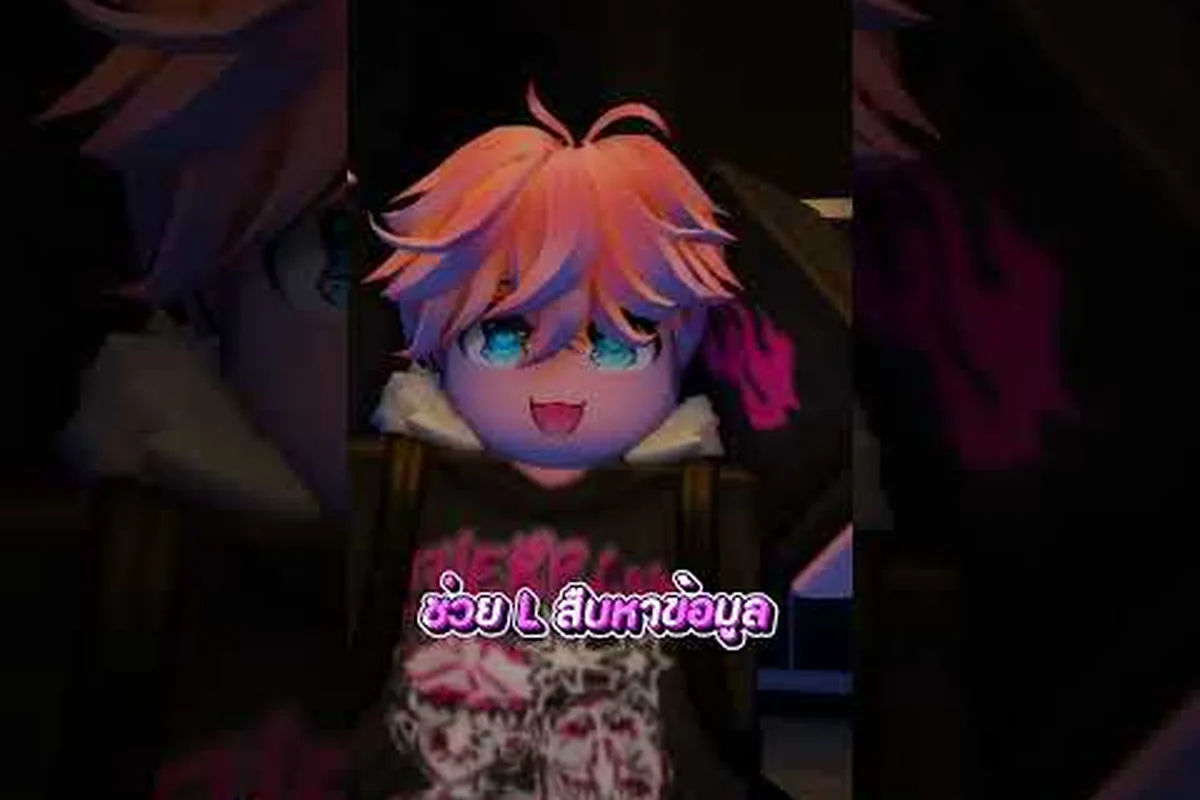
BloxNote story is a tight, social deduction retelling of the Death Note manga arc, compressed into 10-15 minute rounds. Every round replays the same beats: a notebook surfaces, a killer strikes, an L role investigates, and the case eventually breaks toward a successor. The whole experience is a love letter to the canon, and once you know which anime beat each in-game moment references, every roleplay and accusation lands harder. That said, the campaign's standout performance still belongs to the masked detective whose quiet deductions anchor every roundtable, and if you want a refresher on exactly what drives his obsession with the case, see our Who Is Kira breakdown before the next phase drops.
The BloxNote Story Arc Explained
The BloxNote story borrows its skeleton directly from Death Note and trims the cast down to what a round can support. There are only three named role slots: Kira (the killer, played in the spirit of Light Yagami), Kira Follower (a helper role that maps loosely onto Misa Amane and the Yotsuba group), and L (the detective). Below them sits the Investigator team, which performs the same job as the original Kira investigation team, while a Shinigami Eyes passable item references the Ryuk and Rem elements of the source material. Every round restages the same central conflict: can the L role prove who the Kira is before the notebook writes too many names?
| Story Beat | Death Note Source | BloxNote Equivalent |
|---|---|---|
| Notebook drops in | Ryuk drops the Death Note | A random player spawns as Kira with the Death Note |
| First public kill | Light tests the notebook on criminals | The Kira role kills to establish Fear Aura |
| Investigation begins | L takes the case | L uses Deduction Ping to narrow suspects |
| Kira Follower appears | Misa Amane, Yotsuba arc | Kira Follower triggers 2nd Kira ping |
| L is removed | L's death, broadcast scene | L is voted out, Successor spawns |
| Final confrontation | Near's warehouse gambit | Mello bait leads to a notebook swap resolution |
Each of these beats is tied to a visible in-game signal, so a player who has read the manga can predict the round's pacing from the first vote. The game does not invent new lore; it condenses and repackages, which is why the timeline below is the fastest way to read a round.
Why the Timeline Matters for New Players
A new player who walks in mid-round often cannot tell whether the L is bluffing, whether a near-certain accusation is real, or why two roles appear to act like a "second Kira." Those moments only make sense when you know which beat you are on. Treating a round as a five-act play removes about 80% of the social deduction noise that new players complain about, because every accusation now maps to a canon moment rather than improvisation.
Act 1: The Notebook Surfaces and BloxNote Light Begins
The BloxNote story opens the same way the manga opens: a notebook appears in the world and a single player is chosen to use it. That role is called Kira, the in-game namesake of the manga's Light Yagami, and the round has officially begun. The chosen player can only kill by writing a target's true display name, which mirrors Light's requirement to learn a real name before writing it.
| Phase | In-Game Action | Canon Parallel |
|---|---|---|
| Kira spawns with Death Note | A glowing notebook enters the inventory | Light finds the Death Note in the school yard |
| First write attempt | Must whisper the target's true name | Light experiments with a criminal's face broadcast |
| 30-second cooldown | Each kill locks Kira for half a minute | Light's early restraint mirrors the manga |
| Kira Follower reveals | A second ping highlights Kira's helper | Misa's televised confession triggers 2nd Kira |
Players who know the BloxNote Light arc recognize that early-game pacing mirrors the first three episodes almost beat for beat. The opening 90 seconds of a round are designed to lull the Investigator team into treating Kira like a random social role, which is exactly the mistake the canon investigation also made in the early chapters.
Reading the Kira's Opening Move
In Death Note, Light's first public kill is a televised criminal who is being monitored by police. The BloxNote equivalent is the first kill happening in a high-traffic social area, like the central plaza. If you see the Kira role kill in front of three or more Investigators, that is a deliberate reference to Light's first on-camera strike, and the L role should treat it as a confession rather than a coincidence. This is also the moment when the L role's Deduction Ping first becomes useful, because the kill location is public.
Act 2: The BloxNote L Character and the Lawliet Investigation
Once two or three deaths have been logged, the round enters its longest phase: the investigation. The BloxNote L character takes over, named for and patterned on L Lawliet from the source material. L's visual quirks are flattened into a single in-game icon, but the behavioral cues are preserved. The L role crouches by default, communicates in short clipped sentences, and is the only role that can formally accuse a player in the public vote.
| L Behavior | In-Game Signal | Death Note Source |
|---|---|---|
| Crouched stance | L is shorter than other roles on screen | L's famous slouch at the investigation desk |
| Deduction Ping | Once per round, a brief sound reveals a suspect's proximity | L narrows suspects through broadcast analysis |
| Public accusation | L can call a name to trigger a vote | L traps Light with a forced TV broadcast in ep. 10 |
| Confession request | L can demand a public denial | L's televised "I am L" reveal |
The L role's job is to convert suspicion into a vote, which mirrors the L Lawliet character doing the same thing on television in the manga. Players who want a quick refresher on the L Lawliet character and the source beats can read the L character profile on Wikipedia), which is the cleanest condensed summary of L's deductive methods. The in-game version is a social role, not a detective simulator, but the timing of an accusation is built around the same dramatic beat.
Why the L Role Falls
The BloxNote L character is designed to lose, and that is the point. Just as the manga's L is removed by Rem writing his name, the in-game L can be voted out by a successful Kira Follower reveal. The mechanics are different (a vote, not a Shinigami), but the dramatic outcome is identical: the investigation loses its leader, and a new face has to step up. Recognizing that L is on a clock is one of the highest-skill reads in the game, because experienced L players deliberately over-commit near the end of their run to bait a successor reveal.
Act 3: The Kira Follower, the 2nd Kira Ping, and the L Removal
The third act of the BloxNote story is where the round's most cited canon moment lands: a second Kira appears. In the source material, this happens twice, once with Misa Amane and once with the Yotsuba group, and the game condenses both into a single role called Kira Follower. The Follower can perform a smaller version of Kira's kill, but only after the original Kira has written two or more names, which preserves the manga's "second Kira requires permission" mechanic in a simplified form.
| Follower Mechanic | Trigger | Canon Parallel |
|---|---|---|
| 2nd Kira ping | Once per round, after 2 Kira kills | Misa's televised confession, ep. 6 |
| Kill cooldown 60s | Longer than the main Kira | Light restricts Misa to control the case |
| Forced reveal | If Kira dies, Follower inherits the notebook | Near's gambit when Light loses ownership |
| Vote bait | Follower can be sacrificed to draw out L | Rem trades her life to save Light |
The 2nd Kira ping is the single loudest in-game signal, and players who ignore it almost always lose the round. The Follower's job is to make the L role panic-accuse, which is the same dynamic that gets the canon L killed in the manga. Skilled L players will deliberately ignore the Follower in order to track the original Kira, which is also what the canon L does in the second half of the manga.
How the L Vote Triggers Succession
When the L role is removed, either by vote or by being framed, the round enters its final act. The game does not run a straight "L is gone" cutscene, instead it spawns a new detective role called Successor on the Investigator team. The Successor is a flexible slot that takes either the Near or the Mello archetype, depending on the player who picks it up. The two archetypes are mechanically different and that difference is the entire point of the late-game design.
Act 4: BloxNote Near, BloxNote Mello, and the Successor Rivalry
The successor arc in BloxNote canon is the most faithful part of the game to the manga. Two distinct sub-roles, Near and Mello, mirror the rivalry in the final stretch of Death Note, and each one is mechanically tuned to a different playstyle. Near is patient and deductive, modeled on the manga's warehouse gambit; Mello is loud and aggressive, modeled on Mello's Wikipedia profile, which describes the same risk-taking, high-variance approach.
| Successor | Playstyle | In-Game Mechanic | Canon Beat |
|---|---|---|---|
| Near | Patient, deduction-first | Truth Trap reveals a suspect's alibi when triggered | Near's notebook-swap gambit |
| Mello | Aggressive, sacrificial | Bait Kill removes one suspect at the cost of revealing yourself | Mello trading his cover for a lead |
| Hybrid | Reactive only | Acts as a generic successor if both slots are unfilled | Matsuda's late-game stand-in |
Choosing between Near and Mello is the most important decision an Investigator player can make, because the two roles have opposite win conditions. Near wins by waiting for the Kira role to over-commit, which is the same thing the manga's Near does in the warehouse. Mello wins by forcing the Kira role to react under pressure, which is the same thing the manga's Mello does when he kidnaps Kiyomi Takada.
Reading a Near Round vs. a Mello Round
A Near round usually ends quietly, with one or two low-drama votes and a final accusation based on alibi logic. A Mello round usually ends in a fight, with the Successor role taking a personal risk that draws a defensive reaction from the Kira camp. Players who can tell which successor is in play within the first 30 seconds after L falls can plan their next two votes around that style, and that single read is the difference between winning and losing the final act.
Act 5: The BloxNote Canon Ending and the Notebook Resolution
The final act of the BloxNote story is a compressed version of the manga's last three episodes. The Successor forces the Kira role into a position where writing one more name is a confession, and the round resolves with a vote or with a Notebook Swap mechanic that mirrors Near's warehouse gambit. The two endings are mechanically different but thematically identical: the case closes because the detective team finally owns the notebook, and the round resets.
| Ending | Trigger | Canon Source |
|---|---|---|
| Vote conviction | L or Successor calls a successful vote | L's televised reveal, ep. 10 |
| Notebook Swap | Successor writes a name first | Near's gambit, ep. 24 |
| Kira collapse | Kira Follower over-commits | Misa's forced retirement arc |
| Reset | Round timer runs out | Same as the manga's drawn-out stalemate |
There is no canon "good ending" in the game. Both sides can win, and the round is designed so that the result is determined by social reads rather than by mechanical farming. That is the BloxNote canon's core design choice, and it is also the reason the game is recommended to players who already enjoy the source material.
Why Some Rounds Drag
A round that does not resolve cleanly usually stalls in Act 3, when the Kira Follower ping has fired but the L role refuses to commit. This is the same dynamic that gets the manga's L killed: too much data, not enough action. The fix is always the same: the L role should make a public accusation in Act 3 even if the evidence is thin, because a wrong accusation is recoverable and a slow round is not.
Frequently Asked Questions
Is the BloxNote story canon to Death Note?
No, the BloxNote story is a fan retelling, not a canon extension. Every beat is borrowed from the Death Note manga or anime, but the round structure is original. Players looking for a clean summary of the source material can use the Light Yagami character article as a reference, since the BloxNote Light role is built on top of those scenes.
Who is L in BloxNote?
L in BloxNote is the L character role, named after L Lawliet from Death Note. The role leads the Investigator team, can call public votes, and is the only detective slot that can formally accuse a player. When L is removed, a Successor spawns to take over.
What is the difference between BloxNote Near and BloxNote Mello?
Near is the patient successor role, with a Truth Trap mechanic that reveals alibis; Mello is the aggressive successor role, with a Bait Kill mechanic that removes suspects at a cost. Both sub-roles are unlocked only after L is removed in the current round.
Does the Kira Follower have to be a real friend of the main Kira?
No, the Follower role is assigned independently by the game and is not chosen by the main Kira. The Follower is a separate spawn, and the main Kira cannot control who gets the slot. The 2nd Kira ping only reveals the Follower's presence, not their identity.
Can the round end without a successor?
Yes, if the Investigator team resolves the case before L is removed, the round ends with a clean conviction and no successor spawns. The Successor arc is only triggered when L is voted out, removed by the Follower, or otherwise eliminated before a public vote succeeds.